Dynamic Warm-Up for Injury Prevention and Performance
Craig Depperschmidt PT, DPT, PRC
ProActive Physical Therapy and Performance Center

Running is not exactly easy on our body. Injuries and management of the injuries are a part of the sport. You can be smart about training and recovery and still end up with an ache that limits your ability to complete that goal race. Addressing sub-optimal biomechanics is often key to staying healthy and reaching your goal.
Fortunately most running injuries can be addressed by working with a physical therapist who can coach you on proper corrective exercises, and occasionally manual techniques to get you running well. We have found that the vast majority of running injuries are often “fixed” by the athlete themselves by doing the proper corrective exercises with occasional running technique modifications.
One thing we have found with running is that certain muscle groups tend to be overworked while others tend to be underutilized. It is the nature of the sport. As an example with cycling, the tire in the back wears about 75% faster than front tire because most of the weight is in the back and it is the drive wheel. So, a cyclist will rotate their tires as they know the back tire will overwork more than the front tire. This improves the longevity of the tire.
To improve our body’s longevity and resiliency it helps to strengthen those muscles that are underutilized with running, while stretching or inhibiting the overworked muscles. This helps prevent imbalances from occurring, and thus prevent injuries in our running program. Therefore, it would be ideal to create a warm up routine that strengthens those underutilized muscles while stretching or inhibiting those overworked muscles.
The muscles that tend to over work with running are our back muscles, hip flexors, quad muscles, and calves. So a good warm up routine should stretch or inhibit those muscles. The muscles that need facilitating are our abs, gluteals, hamstrings, and adductors. A warm up routine to activate or strengthen those muscles would be ideal.
We have created a routine that does just that! Now, every runner is unique and if you are dealing with an injury go see your physical therapist. These are not meant to treat any injuries. However, they can be used to improve your body’s resiliency to prevent future issues. Give them a try and let us know what you think!
Dynamic Warm Up for Injury Prevention and Performance:
1) Inchworm
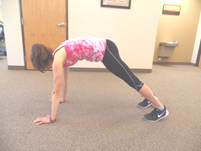
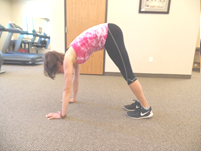
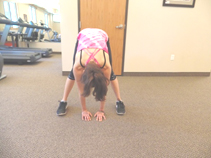
Start on your hands and knees. Round your back and “push” the floor away from you, spreading your shoulder blades apart. Straighten your legs and allow your heels to relax back. Take short steps and walk your feet towards your hands. You should feel your abs engage and your calves and back stretch. Take 5 deep breaths. Walk your hands out and repeat 4 more times.
2) Lateral Walks
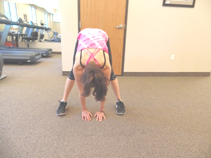
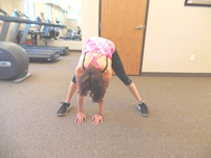
With your feet slightly wider than hip-width and your knees bent, round forward and place your palms on the ground. Take a step out to the side, landing heel first. Bring your opposite leg towards the other, landing heel first. Slide your hands on the ground as you make your way laterally across the floor. Go 10 steps. Repeat going in the opposite direction for 10 steps. Take deep breaths while doing this to feel your back expand and stretch.
3) Bear Crawl
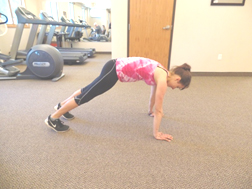
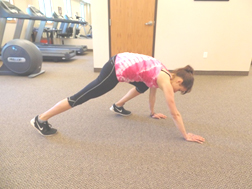
Start on your hands and feet with your back rounded and your “tail tucked”. Push the ground away from you as you spread your shoulder blades apart. Reach forward with your left arm and right knee. Take a deep breath in and out. Alternate reaching forward with right arm and left knee. Take a deep breath in and out. Be sure to keep your “tail tucked” and your abs engaged. Continue this sequence for 10 steps, going slow.
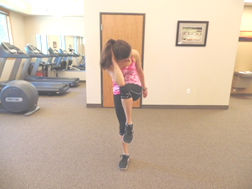
4) Alternating Cross-Overs
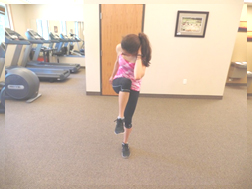
Stand with your back relaxed and ribs down. Raise your right knee as you reach across with your left elbow and allow them to contact. Take a deep breath in and out. Alternate raising your left knee and reach across with your right elbow. Take a deep breath in and out. Continue this sequence for 10 steps, going slow.
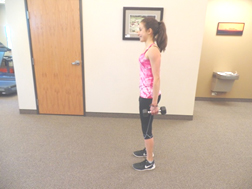
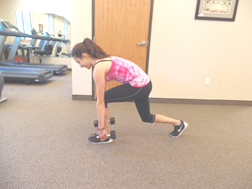
5) Gorilla Walking Lunge
Take a big step forward, landing heel first. Round forward and reach for your heel. Take a deep breath in and out. Push through your heel to return to upright. Step forward with the other leg, landing heel first. Round forward and reach for your heel. Take a deep breath in and out. Push through the heel to return to upright. Continue this sequence for 10 steps on both sides.
So give this warm up a try on your next few runs. If you have an ache or pain, get after it ASAP and give us a call at 970-224-4141. You can also visit us at www.proactiveptcenter.com
If you are interested in a training plan with a focus on improving your body’s resiliency and preventing injuries, check out www.elementstrainingcompany.com